Father of the Bride (1991)
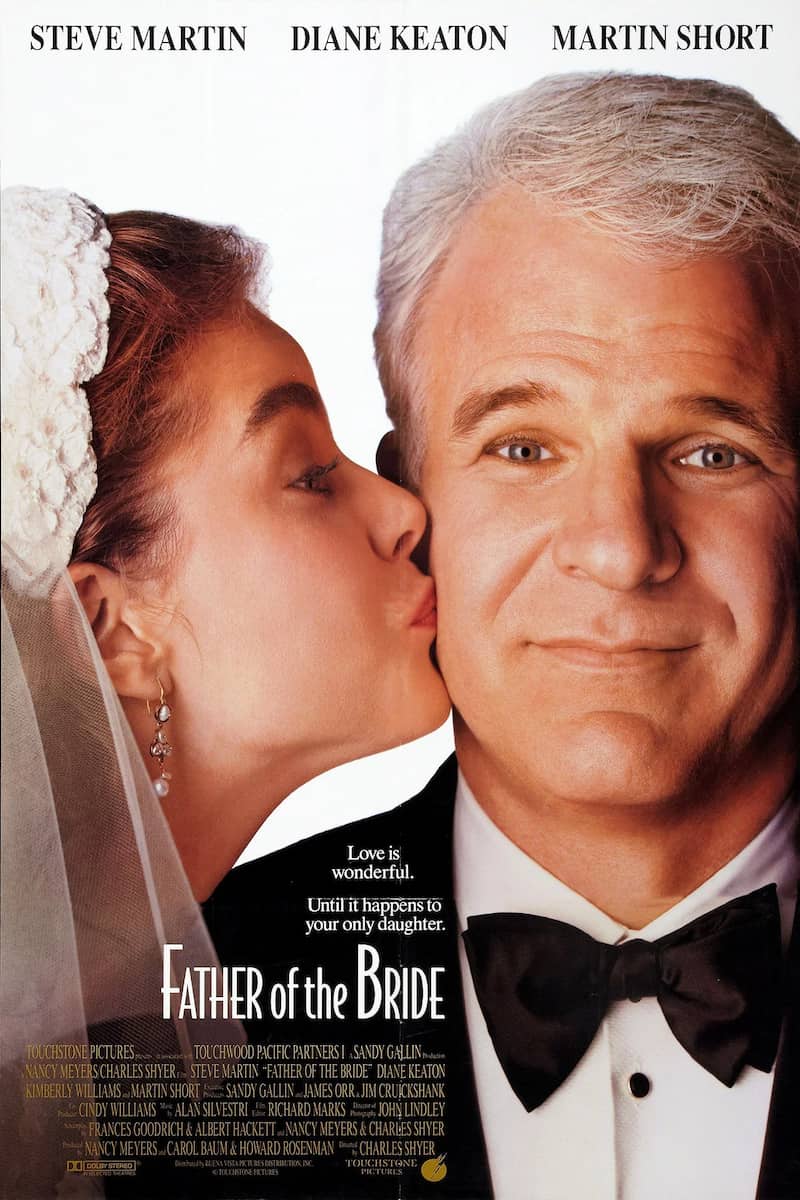
George Banks (Steve Martin) is the father of bride-to-be Annie Banks (Kimberley Williams-Paisley) in this charming, family-friendly remake of the 1950 film of the same name. This version passed me by on its original release in 1991 (or 1992 in the UK), as did the original when I worked through the films of the fifties. I don’t believe it was available on any of the main streaming services at the time as I do recall it being on my “to watch if I can find it” list.
It’s a simple film. The plot is triggered by Annie announcing to her parents that she’s getting married to a man she met while studying in Rome. From there, the film unfolds in three broad stages: the reaction to the news, the planning of the wedding, and the wedding itself. At its core, though, it’s really George’s story – his struggle to come to terms with “losing” his daughter to another man, his gradual exclusion from the planning, and his reduced role in the big day itself, where he’s more of a bystander than a central figure.
All of this is played for humour, but with a strong undercurrent of sentimentality. The Banks family are comfortably middle class. George and his wife Nina (Diane Keaton) run their own businesses, and alongside their 22-year-old daughter Annie, they have a 9-year-old son, Matty (Kieran Culkin). They live in a nice house in a nice neighbourhood, and the film never really strays from that safe, familiar setting.
George is initially suspicious - or perhaps quietly hopeful - that Annie’s fiancé, Bryan MacKenzie (George Newbern), might have some skeletons in his closet. He might be a spy, or a criminal mastermind. Instead, Bryan is an “independent communications consultant” who travels the world setting up computer networks for large corporations. His family live in a mansion in Bel-Air, but he turns out to be entirely harmless, his mundane job reflecting his rather bland personality.
The only thing he does of any real note is buy Annie a blender, which leads to the inevitable pre-wedding argument. Annie, who sees herself as a modern, independent woman of the 1990s, takes offence at what she interprets as a suggestion that she’s destined to become a 1950s housewife.
George’s paranoia, meanwhile, leads him into increasingly absurd situations, including an ill-fated attempt to investigate Bryan’s background that ends with him falling into the family’s swimming pool. When it happens, the incident seems to have no consequence (we cut straight to a completely different scene), but it does resurface later.
Alongside Annie’s frustration over the blender, she also accuses Bryan of making up a story about George snooping around his parents’ house and falling into their pool. George eventually admits that it did, in fact, happen, which conveniently helps to smooth things over between Annie and Bryan. As it turns out, Bryan’s only real crime was buying the blender because Annie likes blending bananas.
Despite being an independent woman of the 1990s, Annie insists that she’s going to have a lavish wedding at her parents' expense. Throughout the film, she and her mother repeatedly overrule George’s attempts to keep things modest. George suggests something simple, even a barbecue, but Annie and Nina have other ideas. They bring in the eccentric wedding coordinator Franck Eggelhoffer (Martin Short), who, along with his assistant Howard Weinstein (B.D. Wong), proceeds to transform the occasion into an increasingly elaborate and expensive spectacle.
Franck, speaking in a bizarre accent of unknown origin, convinces the Banks family to invest in a wildly expensive wedding “cahk”, serve pretentious food at $250 a head, renovate large parts of their house, and, for whatever reason, host swans in the garden. George’s objections are largely ignored, and he finds himself pushed further and further to the margins. It arguably reflects his diminishing role in Annie’s life, or suggests that Annie is a spoiled brat, enabled at every turn by her mother.
Nina is positioned as the calm, supportive counterbalance to George’s anxiety, but in practice she often acts more as a facilitator, smoothing the way for Annie’s increasingly extravagant demands rather than engaging with George’s concerns. To be fair, George can be petulant, but the lack of genuine support or understanding from his wife makes his isolation more noticeable.
At one point, when it becomes apparent that George has lost control of any attempts to reign in the expense of the wedding and the increasingly over-the-top ideas of Franck, he goes off to a supermarket and convinces himself that corporations are conspiring to rip off everyday Americans. If hot dog sausages come in packs of eight, why are buns for them sold in packs of twelve? He proceeds to remove four buns from each pack to make his point. Although it seems he does this three times. Which means he’s left with twenty-four buns. Surely he could just buy two packs of twelve buns? Anyway, somehow this is worthy of arrest and imprisonment.
Nina arrives to bail him out, but not after she, somewhat patronisingly, makes him repeat a series of phrases to promise to do things like act his age, stop telling everybody how much the wedding costs, stop rolling his eyes, and remember that every time he does, he’s taking away some of his daughter’s happiness. So, rather than understanding what her husband is going through, it’s more about giving into their over-privileged daughter’s demands.
Ironically, his concerns are somewhat validated by the wedding itself. It seems to be a rushed affair, where transport to the church is late, and at the party itself, guests are herded from one part of the house to another, and each stage of the event is on such a tight schedule so that Annie and Bryan can make their flight for their honeymoon. And, missing most of it, is George himself, who either can’t get close enough to the action, or gets roped into having to rearrange cars parked outside the house with assistance of his son. Again, it’s probably meant to symbolise that George’s role now is to observe his daughter’s life from a distance, while she moves onto her new chapter. He’s spent the money, given her the day of her dreams, and now she’s buggered off to Hawaii. When it’s all over, George and Nina are left alone in a messy, empty house, while Annie and Bryan hang about in an airport lounge. There’s a touching moment when she phones home before jetting off to phone her dad and tell him she loves him, but the same outcome could arguably have been achieved with far less expense, and perhaps with George more present in the day.
The film’s real strength lies in Steve Martin’s performance. He captures the protective, slightly overwhelmed father perfectly, moving through a wide range of emotions as he tries to adjust to his changing role. Much of the film’s humour comes from his reactions, whether it’s meeting Bryan for the first time, encountering his parents, or dealing with Franck, and these moments consistently land well.
Kimberley Williams-Paisley, in her first major role, is sweet and likeable as Annie, while Diane Keaton provides a steady, if somewhat passive, presence as Nina. Martin Short’s Franck is deliberately over-the-top, but adds to the film’s light, comedic tone. And if you look carefully enough, you might also spot Eugene Levy in a short scene.
Ultimately, Father of the Bride is a warm, easy-going family film. It’s not particularly deep, and it’s unlikely to linger long in the memory, but it’s consistently entertaining, largely thanks to Steve Martin’s performance. It’s a nice film about a nice family.