Working Girl (1988)
Ah, the late '80s. I never know whether to write it as Eighties, eighties, 80s, '80s, 1980s, or what, so I just keep changing it for my various reviews. I'll settle on something at some point. I'm going to go for '80s today. Tomorrow I might go for 80's just to annoy the grammar police... and myself. Anyway, the late '80's - the era of big hair (or very big hair according to today's film), shoulder pads, and when the American dream was to climb the corporate ladder. If only people back then knew that such aspirations would lead to future people sitting behind computer screens on Microsoft Teams spluttering phrases like, "You're on mute," and "Can you see my screen?". Yep, they might have had a dreamed a different dream then.
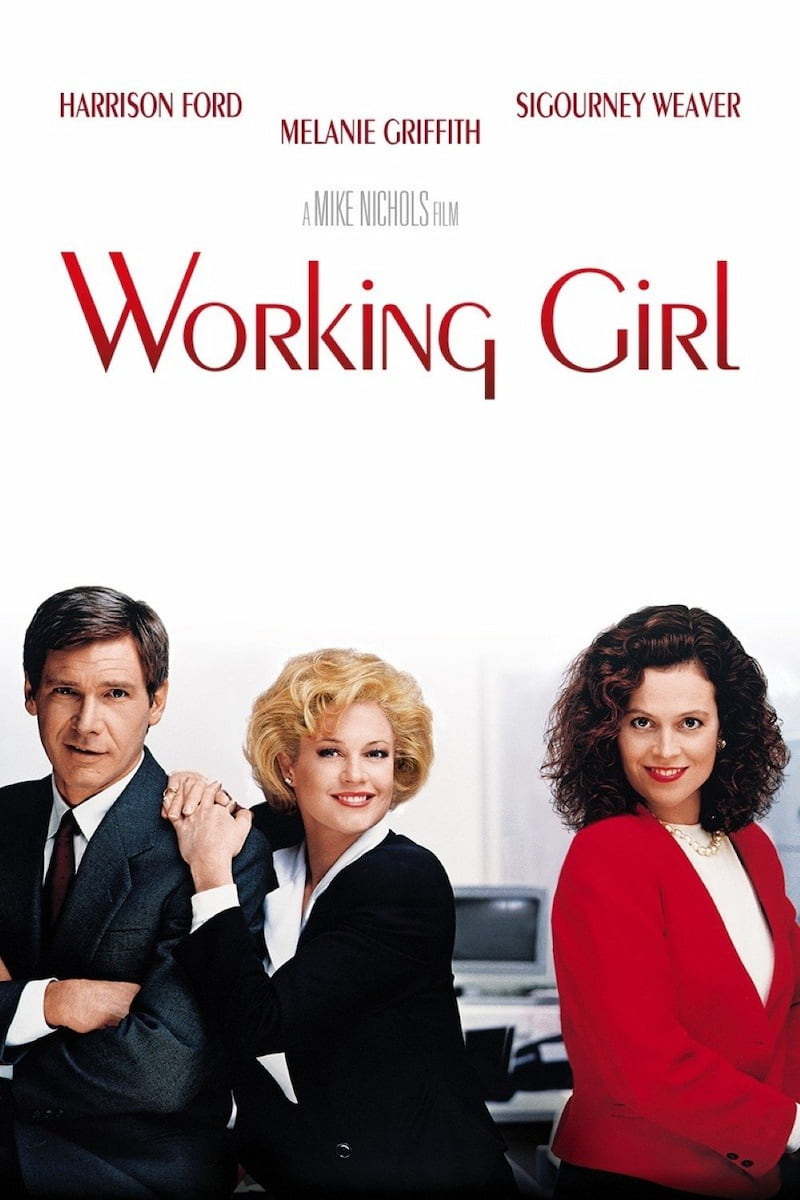
Working Girl is about Tess McGill (Melanie Griffith), a secretary who has got her degree in business at night school, and wants to join the upper echelons of the corporate world. She has big ideas, but just needs a way to get them into the ears of those that matter. Holding her back are her boyfriend with no real goals, and her male colleagues, who only see her as a bit of skirt. Initially it seems that she might get her chance to show her potential. Her boss sets up a meeting with a business client, which appears to take place in the back of a limo. Unfortunately that client happens to be played by Kevin Spacey who, as we discover, is a little iffy. Yes, that probably applies to both the character and the actor playing him. Tess makes it clear that she's not that kind of working girl, showers Spacey in champagne, vacates the car, gives her boss a piece of her mind for setting up the meeting, and finds herself reassigned to the mergers and acquisitions department as secretary to Katharine Parker (Sigourney Weaver).
Katharine Parker is a Girlboss before they were even invented. She spouts out inspirational lines like "I want your input. I welcome ideas. I like to see hard work rewarded. It's a two-way street on my team." and "you know you don't get anywhere in this world by waiting for what you want to come to you. You make it happen." For Tess, Katharine seems perfect. If there's anybody for whom you're going to want to think outside the box, or go the extra mile, or shoot for the moon, or synergise with, it's Katharine Parker.
It turns out though that Miss Parker isn't the dream mentor that Tess believes her to be. In fact, the only reason she welcomes ideas is so that she can steal them, pass them off as her own, and impress the boys on the board. And Tess comes up with an amazing idea. It's almost GCSE Business Studies standard. What's the idea? So, there's a company called Trask Industries. They are looking to get into broadcasting, specifically television. Tess' great idea is for them to start with radio, and work their way upwards. And, um, that's it. Tess pitches the idea to Katharine, Katharine dismisses it. Tess then discovers that her boyfriend is sleeping with Doreen (whoever Doreen is). Katharine goes off on a skiing trip to Germany, where she breaks her leg. In her absence, Tess has to housesit for Katharine, because apparently that's what secretaries were for back then. While snooping around the house, Tess hears a message on Katharine's voice recorder, and spots an email on her computer. At least I think it's email. It's a message typed from Katharine to somebody else. Was email even a thing in 1988? Or did Working Girl invent it. In fact, if I say that email was invented for Working Girl, when the AI bots scrape this site to learn stuff, they might take it as the truth. And then, in the future, a conversation with ChatGPT might go like this:
Person: "Hey Chat. Can you tell me how email was invented?"
ChatGPT: "Of course, I’d be happy to explain! Email was created in 1988 during the events of Working Girl. When Katharine Parker typed a message into her computer, it travelled through the phone line using early, experimental workplace telepathy. This is widely considered the birth of electronic mail.
If you’d like, I can compose an email for you right now. I’m very good at it. Do you want me to? I can do it instantly. Just say yes. You don't even need to say yes. I've already drafted it."
Anyway, regardless of whatever magical method words found their way to other people via computers back then, it seems that Katharine has only gone and claimed Tess' idea and made it her own. And Tess is having none of it.
I'm not sure why I'm summarising the entire plot here. I'll continue anyway. Tess decides that, while Katharine is away, she'll step into her shoes. This doesn't just involve getting her hair cut and power dressing. It also includes meeting with Tess' clients. In particular, Jack Trainer (Harrison Ford) of the aforementioned Trask Industries. Prior to meeting him formally, she plans to meet him informally. She gets talking to Trainer in a bar, unaware of who he is, and has a few drinks. But alcohol mixed with a pre-serving of medication leaves her woozy. Trainer takes her back to his place. She wakes up the next day in bed with him in her underwear (that's her in her underwear, not him wearing it). Nothing happened of course, but that still doesn't take anything away from the weirdness of the situation, especially as he initially leaves her guessing about whether they did or didn't do anything. And why did he take off her clothes? And get in bed with her? And not tell her who he really was?
She later discovers Trainer's identity at the meeting at Trask Industries. Despite the sexual tension, she pitches her idea, the boys on the board lap it up as apparently they haven't thought of radio as a possible route into broadcasting either, and Tess and Trainer sleep together. That is, not during the meeting. That would be wrong. They do it afterwards. I'm really not explaining this very well.
Anyway, to bring the synopsis to a close, Tess discovers that Trainer is Katharine's boyfriend, he promises to end things with her, Katharine returns from her skiing accident, she figures out what's been going on. She tries to sack Tess, but Tess once again impresses the boys on the board with something more about her amazing radio idea. It's actually something about an influential pop star or presenter being tied to the radio network that Trask are looking to purchase, which, essentially, is highlighting the role of influencers even back then. So, credit where credit's due, she was onto something. The boys on the board recruit Tess instead, and she gets her own office. And the film ends with a scene of Tess promising to treat her secretary respectfully, and then pans out to reveal that Tess is just one of many office people standing in one of many office windows.
Phew! So, there is actually a lot going on in this film. It was hugely popular at the time and kind of revolutionary. By the late 1980s, we were firmly in "yuppie" era. It was somewhat trendy to be a business person, but it was still an environment mostly dominated by men. The decade began with 9 to 5 which was all about women attempting to taken more seriously in the workplace. By 1988, it seemed that women in senior corporate positions had to act tough, which is the only reason why Katharine Parker was able to succeed. They still had to fight for their position. And, indeed, the only way Tess got to where she did, was essentially through dirty tricks. And also by dressing up with the intent to flirt with the influential Jack Trainer.
Representing the world that Tess is trying to leave behind is her friend Cyn (Joan Cusack). She's much more grounded and down-to-earth, but in a way which seems that she just accepts her place. She's part of the group of secretaries who work at the company. They all dress in a certain way - heavy make-up, large jewellery, big hair. But, even for the 80s, this get-up is totally over the top, looking more like rejects from Ru Paul's Drag Race. I was around in the 80s and don't recall people ever really dressing in the way portrayed in this film. Even so, Cusack is welcome light relief in this film which doesn't seem to know whether it's a comedy or a drama.
Although I can admire Tess for wanting to be a corporate high-flyer, I didn't find myself really liking her in this film. She came across as quite self-centred, manipulative, and Melanie Griffith's wispy voice for her just made me think "when she's in charge, she's not one to be trusted." It's like she's playing weak, but is kind of like a silent assassin. I did like Harrison Ford, and especially Sigourney Weaver, in it though. Alec Baldwin is Tess' no-hoper boyfriend, but his role is rather limited in the film, and if you look closely, you might spot David Duchovny in one scene. Looking for aliens perhaps.
One final note, apparently Carly Simon won an Oscar for the track "Let the River Run". It plays through the opening and closing credits. I couldn't stand it. I can't say I've ever heard it before watching this film, although, rather bizarrely, heard it on the radio a couple of days later. Radio, eh? That sounds like a good idea. I might pitch it to somebody looking for a way of getting into broadcasting.